
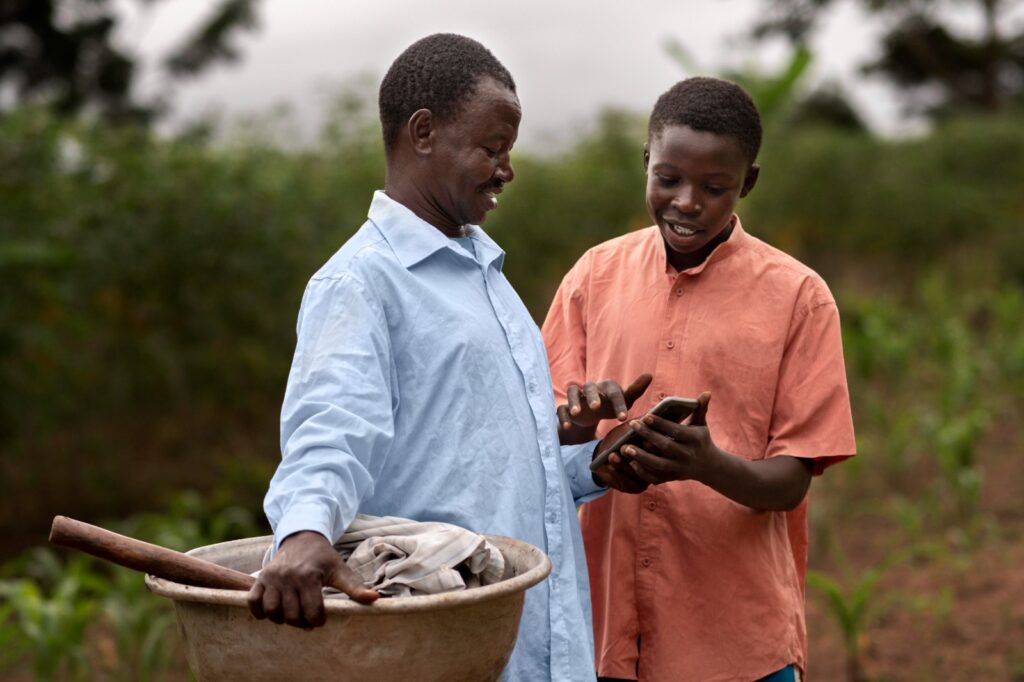

The rooster crows before the sun has fully committed to the day. Smoke rises from a small kitchen as tea boils over an open fire. Three cows shuffle in a modest enclosure, waiting to be led out to graze on a farm that is, by its owner’s own admission, “not big enough.”
Shaban has farmed this land in Kakamega County for decades. Life has been like this, or has changed just a little, ever since he was born. He is a father of five, married to Rozina, a woman he describes as hardworking without exaggeration. Before he plants anything, he studies the sky: the clouds, the wind, and the mood of the insects in the grass. It is forecasting learned through a lifetime, not downloaded from anywhere.
Ask him about artificial intelligence, and he laughs, genuinely puzzled. “AI? What is that?”
A familiar app, an unfamiliar idea
Shaban’s compound is not untouched by the digital world. On slow afternoons, one of his younger children can often be found hunched over a borrowed smartphone, scrolling TikTok, laughing at a skit filmed in Nairobi, or watching a farmer in neighboring Bungoma demonstrate a trick for keeping chickens healthy. TikTok, somehow, found its way to Lurambi. Artificial intelligence, so far, has not.
The question worth asking is why one traveled so easily, and the other has stalled at the village edge.
The answer may lie less in the technology itself than in how it arrived. TikTok never asked villagers to understand algorithms or recommendation engines. It simply offered something irresistible: entertainment, connection, a glimpse of lives elsewhere, and let curiosity do the rest. Nobody needed a manual. A teenager showed a cousin, who showed a friend, and within months the app was as familiar in rural Kakamega as in Nairobi’s estates.
Artificial intelligence has taken the opposite path. It arrives in villages, when it arrives at all, dressed in unfamiliar language, terms like “machine learning” and “large language models,” and vocabulary with no roots in the soil Shaban tends. His eldest son, Meshack, now training to be a teacher at the Masinde Muliro University of Science and Technology (MMUST), uses AI tools comfortably, asking a chatbot to help outline a lesson or explain a difficult concept. But that fluency has not yet traveled home the way TikTok did, dance by dance, joke by joke.
Not resistance, but invitation
This is not, researchers say, a story of rural resistance. Villages like Lurambi have proven, repeatedly, that they will adopt whatever proves useful or delightful. Mobile money transformed how farmers get paid. Radio and television remain fixtures despite unreliable electricity. TikTok itself required smartphones and data bundles, the same barriers often cited as obstacles to AI adoption, and still it spread. The difference was not infrastructure. It was an invitation.
Nobody had to explain to Shaban’s children why TikTok mattered. It showed them. Artificial intelligence, so far, mostly explains itself, in English, in technical terms, to an audience it hasn’t bothered to picture.
Looking for AI’s sixty-second video
That may be starting to shift. Development workers and technologists increasingly argue that AI’s path into rural life will not run through classrooms or campaigns but through the kind of everyday usefulness that made mobile money and TikTok irresistible: an app that photographs a diseased maize leaf and names the blight, or one that tells Shaban which market in Kakamega town is paying the best price that week.
If that arrives dressed not in jargon but in obvious, immediate value, it may spread the same informal way everything else has: a son showing a father, a daughter showing a mother, over tea, on a single shared phone.
What determines whether a technology takes root in a village or remains at its margins? TikTok arrived in rural Kenya without explanation, carried by curiosity alone, while AI, despite its potential to transform every sector, seems to stuggle to find a language the village recognizes as its own.