
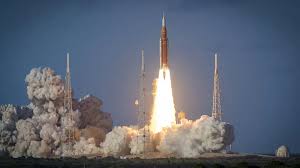

The United States has taken a major step in space exploration with the launch of Artemis II, marking the first time humans have traveled toward the Moon in more than five decades.
Launched by NASA from Kennedy Space Center in Florida, the mission carries four astronauts on a historic journey around the Moon. It is part of the broader Artemis program, which aims to return humans to the lunar surface and lay the groundwork for future missions to Mars.
The mission is the first crewed lunar expedition since Apollo 17 in 1972, signaling a renewed push by the United States to lead in deep space exploration.
Crew and mission details
On board the Orion spacecraft are four astronauts: Reid Wiseman (Commander), Victor Glover (Pilot), Christina Koch (Mission Specialist), and Jeremy Hansen, representing the Canadian Space Agency.
The mission is expected to last about 10 days, taking the crew roughly 400,000 kilometres from Earth. It will orbit and fly past the Moon before returning home, reaching distances not travelled by humans in decades.
The flight also marks several milestones, including the first time a woman and a Black astronaut will travel to the Moon’s vicinity, as well as the first non-American astronaut to take part in such a mission.
Mission objectives
Unlike future Artemis missions, Artemis II will not land on the Moon. Instead, its primary goal is to test systems required for deep space travel.
Engineers and scientists will use the mission to assess the spacecraft’s life-support systems, navigation, communication capabilities and overall performance in the harsh environment of space. The results will be critical in preparing for future crewed landings.
Looking ahead
Artemis II is a key step toward upcoming missions, including Artemis III, which is expected to return astronauts to the lunar surface later this decade.
NASA ultimately plans to establish a sustained human presence on the Moon, particularly around its south pole, and use it as a base for future missions to Mars.
Renewed Global Competition
The mission comes at a time of growing global interest in space exploration, with other nations also pursuing lunar ambitions. As a result, Artemis II not only represents a scientific breakthrough but also highlights the increasing competition to shape the future of space exploration.
The launch of Artemis II marks a historic return to crewed lunar exploration. While it does not include a Moon landing, it lays the foundation for the next generation of missions that could see humans living and working on the Moon once again.