

NASA’s Artemis II crew has safely returned to Earth after completing a landmark mission around the Moon, marking humanity’s first crewed lunar flyby in more than 50 years.
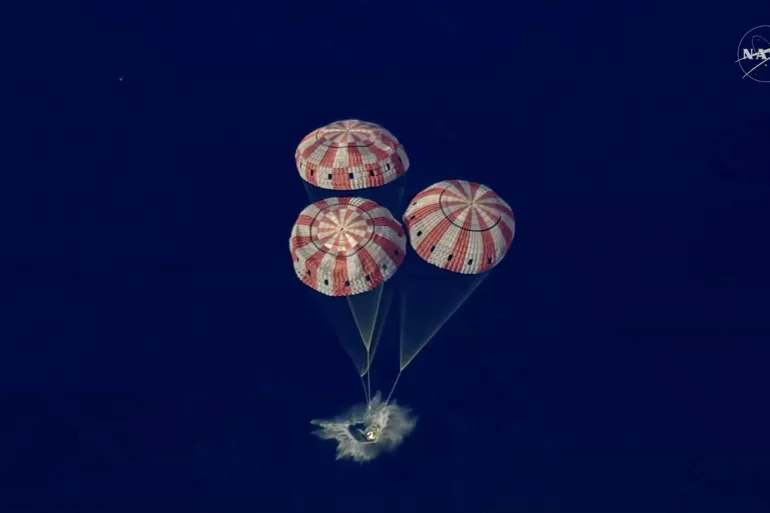
The four astronauts aboard the Orion spacecraft—Commander Reid Wiseman, Pilot Victor Glover, Mission Specialist Christina Koch, and Canadian astronaut Jeremy Hansen—splashed down in the Pacific Ocean off the coast of California on April 10, 2026, bringing an end to a roughly 10-day mission that tested the future of deep-space exploration.
The capsule, named Integrity, re-entered Earth’s atmosphere at extreme speeds of around 25,000 miles per hour before deploying its parachutes for a controlled descent into the ocean. Recovery teams from the U.S. Navy quickly reached the spacecraft and safely secured the crew aboard the USS John P. Murtha for initial medical checks.
According to NASA, the mission achieved several historic milestones. The crew traveled farther from Earth than any humans since Apollo 17, reaching a record distance of about 252,756 miles. The flight also validated critical systems of the Orion spacecraft, including its heat shield, life-support systems, and re-entry procedures—key steps ahead of future lunar landings.
Artemis II is the first crewed mission under NASA’s Artemis program aimed at returning humans to the Moon and eventually establishing a long-term lunar presence. The success of the mission sets the stage for Artemis III, which will aim to land astronauts on the lunar surface later in the decade.
NASA officials described the splashdown as a “critical success,” confirming that all systems performed as expected during the high-risk re-entry phase.
The mission also carried symbolic significance, with several historic firsts: Christina Koch became the first woman to fly to the Moon’s vicinity, Victor Glover the first Black astronaut on a lunar mission, and Jeremy Hansen the first non-American astronaut to travel beyond low Earth orbit.
The Artemis program now moves into its next phase of testing and preparation, as NASA pushes toward future Moon landings and eventual human missions to Mars.