
A centuries-old Catholic tradition has suddenly become the subject of intense online debate after images and video showing the exposed skull of Saint Agatha being venerated during a ceremony in Sicily went viral.
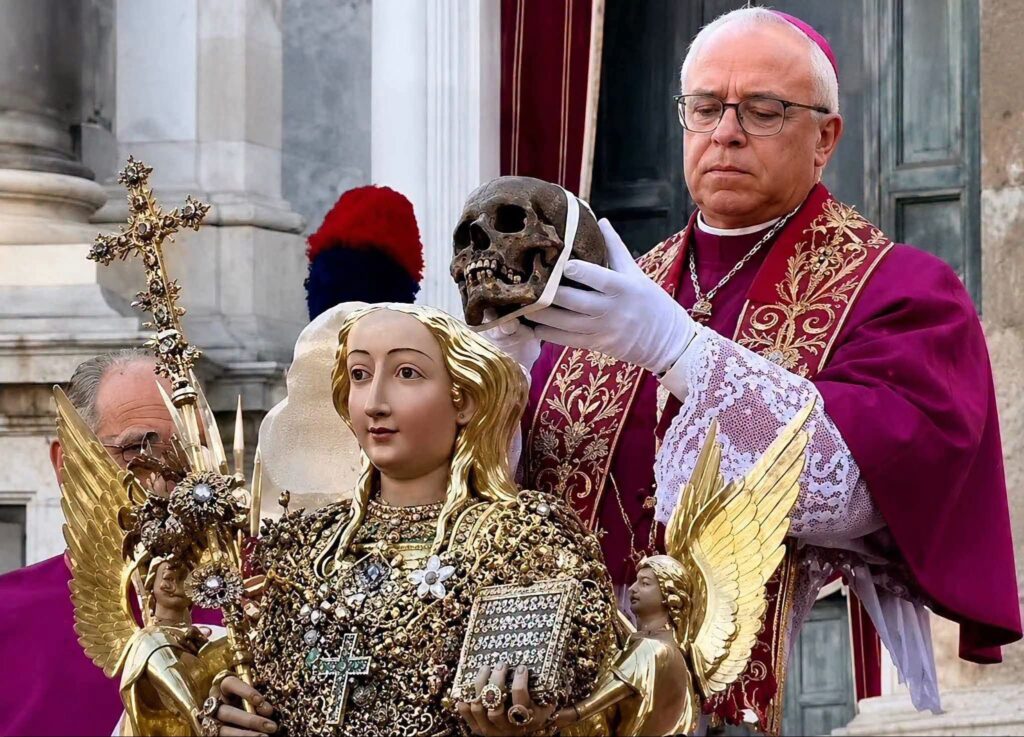
The controversy erupted after Vatican Secretary of State Cardinal Pietro Parolin was filmed bowing and kissing the skull of Saint Agatha during celebrations in Catania, Italy, on August 17. The ceremony marked the 900th anniversary of the return of the saint’s relics to the Sicilian city.
For many people encountering the footage for the first time, the sight of a human skull being carried publicly, kissed and placed inside an ornate golden reliquary appeared strange, disturbing or even incompatible with Christianity.
Social-media reactions ranged from curiosity and attempts to understand the ritual to accusations of idolatry, paganism and “death worship.
Who was Saint Agatha?
Saint Agatha was a Christian martyr who lived in Sicily during the third century and is traditionally believed to have died around AD 251 after being tortured during the persecution of Christians under the Roman Emperor Decius.
She became the patron saint of Catania and one of the most widely venerated female martyrs of early Christianity. Her story has remained particularly important to Catania, where large celebrations are held in her honour.
The Catholic tradition holds that her remains were taken from Catania to Constantinople in 1040. About 86 years later, they were brought back to Sicily. The return on August 17, 1126, is what Catania commemorated this year on its 900th anniversary.
Why was her skull exposed?
The skull is normally kept inside an elaborate silver reliquary bust at Catania Cathedral. In preparation for this year’s anniversary, Vatican specialists carried out conservation work on the reliquary and the veil associated with Saint Agatha.
During the restoration, the skull was removed from the bust and placed in a separate case so that it could be displayed for public veneration. It was returned to its traditional position on August 17 during the anniversary celebrations.
Images from the ceremony show Archbishop Luigi Renna holding the skull before it was placed back inside the head of the reliquary bust. Cardinal Parolin participated in the celebrations as Pope Leo XIV’s appointed Pontifical Legate.
The Vatican had formally appointed Parolin to represent the Pope at the August 16–17 celebrations marking the ninth centenary of the relics’ return.
Why did the ceremony cause such a reaction?
Much of the controversy appears to have resulted from a clash between religious tradition and modern perceptions of human remains.
To people unfamiliar with Catholic relics, seeing a centuries-old skull treated as a sacred object can look macabre. The reactions became particularly strong because photographs and short videos removed the ceremony from its historical and theological context and presented viewers with an extraordinary image: senior Catholic clergy handling, kissing and ceremonially placing a human skull inside a sculpture.
Online discussions have included comparisons with ancestral or traditional religious practices, while some Christians—particularly those outside Catholic traditions—questioned whether venerating human remains amounts to idolatry.