
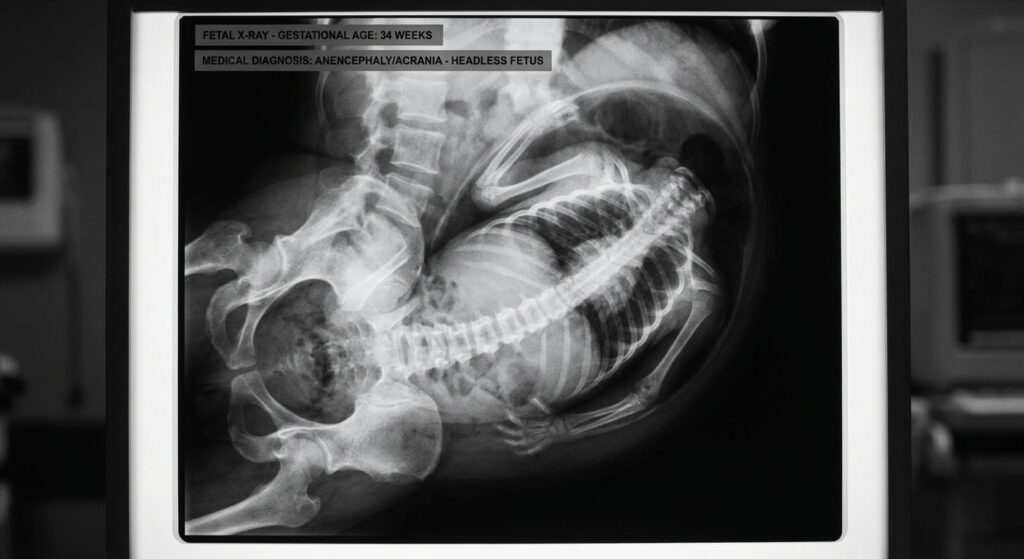

A report from Lugari Constiency, Kakamega County, has brought attention to an extremely rare fetal abnormality after a family claimed that a baby who died in the womb was born without a head.
According to Kristine Nelima, her 20-year-old daughter was seven months pregnant when she started experiencing labor pains on Monday in their home in Kambi Moto, Lumakanda, before she was rushed to the hospital, where she delivered a baby who was reportedly already dead.
Read the story here: Family in shock after 20-year-old woman gives birth to ‘headless’ baby in Lugari
Medical literature has documented cases of complete absence of the fetal head even in singleton pregnancies, although such cases are extremely rare. Researchers say the exact mechanism is not always clear.
What is acephaly?
Acephaly is a rare congenital abnormality in which a fetus develops without a head. It is different from anencephaly, where major portions of the brain and skull fail to develop but the fetus is not completely headless.
Acephaly can occur as part of different developmental abnormalities. It is also important to distinguish it from acardius acephalus, which is most commonly associated with the TRAP sequence in twin pregnancies. Therefore, a baby reported to have been headless in a singleton pregnancy requires a proper medical examination before a specific diagnosis can be made.
What causes acephaly?
The exact cause of acephaly in a singleton pregnancy is not fully understood because so few cases have been reported.
One theory involves amniotic bands. These are strands that can form from the amniotic membrane and, in some circumstances, can become attached to or constrict parts of the developing fetus. Researchers have considered the possibility that such disruption could contribute to the absence of the head in some cases.
However, studies of reported cases have not consistently found amniotic bands. This has led researchers to consider other possible mechanisms affecting fetal development.
Because the condition is so rare, scientists cannot currently point to one single cause that explains every case.